
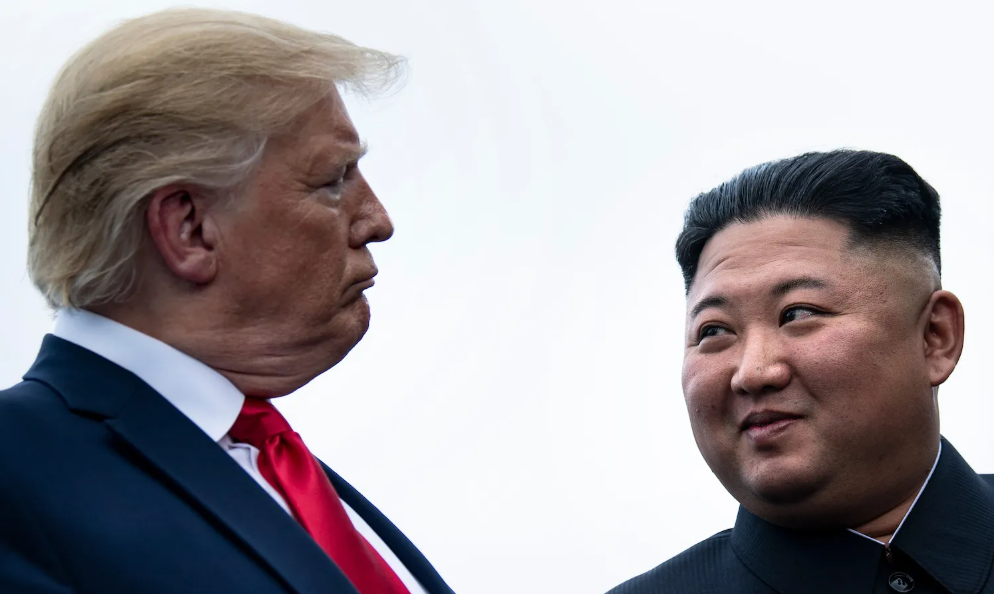
President Donald Trump’s decision to reduce the scale of joint military exercises with South Korea has drawn criticism from former US officials and lawmakers, who say the move could affect Washington’s alliances across Asia.
Trump said he ordered the US military to scale back the 11-day Ulchi Freedom Shield exercises after South Korea declined to join his war against Iran. He also pointed to his relationship with North Korean leader Kim Jong Un, whose government has strongly opposed the annual exercises.
“There is no American interest that I can see in this,” said Dan Fried, an assistant secretary of state for European affairs in the George W. Bush administration. “On all levels it makes no sense. It undermines the South Koreans, undermines the Japanese, frightens the Taiwanese, unnerves NATO and emboldens the Chinese, not to mention the North Koreans.”
Danny Russel, a former assistant secretary of state for East Asia and the Pacific under President Barack Obama, described Trump’s decision as “firmly in the ‘hard-to see-how-it-could-be-worse’ category.”
“It is tragically upside-down. Trump is punishing an ally while encouraging an adversary,” said Russel, now a scholar at the Asia Society Policy Institute in New York. “He is protecting Kim Jong Un’s sensitive feelings from an unfriendly signal at the expense of U.S.-South Korean security.”
Trump Orders Scale-Back Of US-South Korea Military Drills
Trump ordered the US military on Sunday to reduce the size of the Ulchi Freedom Shield exercises, which began on Monday as scheduled. It was not immediately clear which elements of the training would be affected.
The decision surprised many in South Korea, a longstanding US ally where national security remains a major concern because of the threat posed by nuclear-armed North Korea.
The move also faced immediate criticism from Democrats in Congress.
“Treating one of America’s closest allies like an adversary weakens our alliances and benefits China and North Korea,” said Rep. Greg Meeks of New York, the top Democrat on the House Foreign Affairs Committee, in a statement.
Trump returned to the issue on Monday, posting a photograph of North Korean leader Kim Jong Un speaking on a phone. The caption read: “HEY DONALD … WE COOL, RIGHT?”
Retired US Ambassador Robert Wood, who served under both Republican and Democratic presidents, said the joint exercises were important to deterring North Korea, which has rejected talks with Washington over its nuclear programme while continuing weapons testing.
“We also don’t want South Korea to draw the conclusion that a nuclear weapons capability is the only guarantee it has to ensure its security,” Wood said.
Matthew Kroenig, who previously held defence and intelligence positions under Republican and Democratic administrations, said polling showed increasing support among South Koreans for developing their own nuclear weapons.
“The United States has been working really hard to try to persuade South Korea that they are protected,” said Kroenig, now with the Atlantic Council, a Washington think tank. Scaling back the exercises “potentially undermines that message,” he said.
South Korea Sought Closer Ties With Trump
Trump’s decision came after South Korean officials had sought to build a favourable relationship with the US president while dealing with important issues involving trade and defence.
During his meeting with Trump last year, South Korea’s new President Lee Jae Myung praised the decoration of the Oval Office. Lee also agreed with Trump’s assertion that Kim Jong Un would not have pursued his nuclear ambitions if Trump had won a second consecutive term in 2020.
Lee also floated the possibility of a future Trump Tower being built in North Korea.
Trump had appeared only hours earlier to express sympathy for Lee’s predecessor, Yoon Suk Yeol, who was removed from office after imposing martial law in December 2024.
Charles Kupchan, a senior fellow at the Council on Foreign Relations, said the reduction in military exercises could encourage longstanding US allies to consider their security arrangements without relying entirely on Washington.
“They are hoping that the American umbrella is there for the future,” said Kupchan, who worked on the National Security Council under Democratic Presidents Bill Clinton and Barack Obama, “but they have to at least contemplate the idea that Uncle Sam won’t be there for them.”
US Allies Watch Trump’s Defence Policy Closely
Kupchan said Trump was not wrong to expect South Korea and European allies to contribute more towards their own defence. However, he said the president’s unpredictable approach could affect the solidarity supporting those alliances.
Fried said Trump appeared unwilling to “take a win” after pressing NATO members and Asian allies to increase their defence spending.
“NATO is building up, South Korea is building up, Japan is building up. Trump has a problem with taking the win,” said Fried, who is currently at the Atlantic Council. “It’s like he wants to burn it all down.”
John Herbst, a former US ambassador to Ukraine under President George W. Bush, said the decision involving South Korea illustrated what he described as inconsistency in the Trump administration’s policy announcements.
However, Herbst said the US had generally maintained its long-term alliances.
[ANC Defends Senzo Mchunu Over Political Killings Task Team Disbandment]
“If these things grow in frequency and in importance, obviously we will be in the process of taking apart the alliance system, which has served us so well since the end of World War II,” said Herbst, who is also with the Atlantic Council. “But despite some statements which seem to head in that direction, we have not headed there in a consistent, strong way.”
Kupchan agreed, saying that although Trump’s language could be interpreted as “we’re done with you”, the existing US military presence and core alliances remained in place.
“the reality is that, at least as of today, Trump has left intact America’s forward bases and its core alliance relationships.”
SEE TODAY'S TOP HEADLINES ACROSS LEADING PUBLICATIONS
It remains unclear whether Trump’s latest message to South Korea will result in a lasting policy change or prove to be a temporary announcement.
“He’s an unpredictable president,” Kroenig said. “If we move on and the exercises go as planned and we never hear anything about this again, I wouldn’t be surprised.”
