
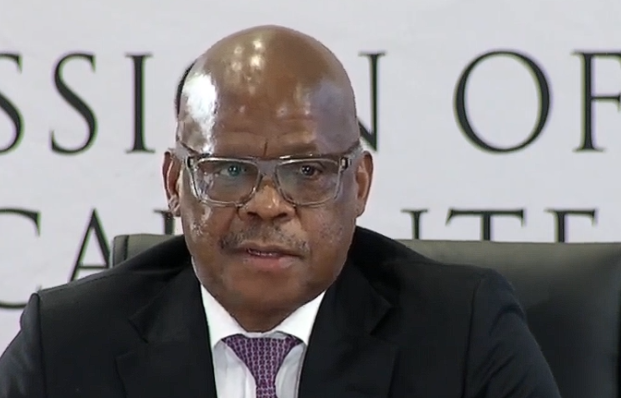
Mpumalanga taxi boss Joe “Ferrari” Sibanyoni is testifying before the Madlanga Commission on Friday, where he is expected to face questions about the taxi industry in Kwaggafontein and alleged criminal syndicates.
Sibanyoni is believed to operate a transport business involving about 400 minibus taxis across Gauteng and Mpumalanga. His name has also featured in another criminal matter after underworld figure Vusimuzi “Cat” Matlala allegedly attempted to assassinate him during an ambush in 2022.
Sibanyoni is currently facing charges of extortion and money laundering. Prosecutors allege that he and his co-accused embarked on a prolonged campaign of threats and coercion against a businessman in Mpumalanga and subsequently extorted and laundered more than R2 million.
The criminal case is separate from the broader allegations being examined by the Madlanga Commission, where Sibanyoni’s name has emerged in testimony relating to alleged criminal networks, corruption and links between individuals in law enforcement and the taxi industry.
Sibanyoni Details Alleged Police Intelligence Links
Evidence presented to the commission has included allegations that Sibanyoni received confidential police intelligence and other sensitive information.
His name has also been linked in testimony to alleged underworld syndicates, violence in the taxi industry and the so-called “Big Five” cartel.
Sibanyoni said information he gathered indicated that the alleged cartel was linked to “the farm”, described as the code name for the headquarters of late taxi boss Jothan Msibi.
He told the commission that he did not know the senior police officers allegedly associated with “the farm”.
Sibanyoni also detailed a message he sent to then Police Minister Bheki Cele on 5 May 2022, in which he sought a meeting to discuss what he described as cartel activity and killings within the taxi industry.
In the message, Sibanyoni wrote:
“Hon Minister Cele I am Mr Joe Sibanyoni a well-known Taxi owner in Pretoria. I am quite certain you are expecting my call as per info given to yourself Minister. My fundamental reason is to seek your audience under these current situation the Country finds itself in, the Covid 19. The Taxi Industry is in the verge of a catastrophic disaster if left unattended even now during Covid 19 — these current Killings of Gauterg and KZN Taxi Operators which 1 personally know of.
“If it wasn’t for Covid 19 Minister, the killings could have easily escalated beyond measure. I certainly request your audience as a matter of urgency to avert more killings of innocent members that will make the source of these killings be impossible to get.
“As I send you this message Minister, be aware that the service delivery around greater Tshwane and surroundings is highly disturbed by the same cartel which I have solid facts оп. Please Minister, it is my belief as a Leader in the Taxi Industry and a senior Citizen [in] SA. It would be very irresponsible of me to keep this information.
“Minister you are the relevant person to get the first-hand information from me. One of the very disturbing facts is that very very Senior SAPS officials are in this Cabe As per your Statement Minister a Policeman cannot die with the Gun in His Har therefore The Taxi industry cannot die when I have such valuable Information. Your favourable response would be greatly appreciated.”
Joe ‘Ferrari’ Explains His Nickname
Sibanyoni also addressed his nickname during his testimony, saying “Joe Ferrari” had no connection to criminal activity.
“I am known by the nickname ‘Joe Ferrari.’ I confirm this. This nickname arose organically from my lifestyle and personality over many years. It is a social nickname. It carries no criminal connotation whatsoever,” he said.
His testimony has also touched on the Shongwe Commission, which investigated violence, fatalities and instability in Gauteng’s minibus taxi industry.
What The Shongwe Commission Found About Taxi Violence
The Commission of Inquiry into Minibus Taxi-Type Service Violence Fatalities and Instability in the Gauteng Province, commonly known as the Shongwe Commission, was established in September 2019 by then-Gauteng Premier David Makhura.
The inquiry was chaired by retired Judge Jeremiah Buti Shongwe, alongside members Rudolph Lungile Mabece and Hlula Msimang.
Its final report, released in early 2021, examined the causes of recurring conflict and killings in the taxi industry, including disputes involving routes, associations and leadership.
According to Sibanyoni’s testimony, the commission found that rogue associations, reluctance among some leaders to leave lucrative positions and regulatory failures contributed to instability in the sector.
He said the Shongwe Commission was one of several investigations into the taxi industry and that the various structural factors identified “operate in combination”.
“They create an environment in which violence is not an aberration but a foreseeable and recurring feature of economic competition. They also create an environment in which senior industry leaders, precisely because they occupy positions of influence within associations and representative bodies, are themselves primary targets of that violence.”
Sibanyoni said 25 witnesses gave evidence to the Shongwe Commission in secret because of concerns about the dangers of speaking openly about the minibus taxi industry.
He also told the Madlanga Commission that he had previously testified before the Gauteng commission, known as the Nkosi-Thomas Commission, which investigated conflict in the taxi industry.
According to Sibanyoni, that inquiry was eventually disbanded because of a lack of funding. He said alleged “Big Five” cartel leader Jothan Msibi had been due to testify before the commission.
Sibanyoni said Msibi had claimed at the time that he was no longer involved in the taxi industry and was instead operating in the construction sector.
Alleged ‘Izinkabi’ And Taxi Industry Killings
Sibanyoni also went through recommendations made by the Shongwe Commission concerning taxi-related violence and investigations.
He said the commission identified the use of hired assassins, commonly known as “izinkabi”, as a documented feature of taxi-related violence.
“Certain killings specifically target the hired assassins after the fact to eliminate evidence of who commissioned the killings. This cycle of assassination, counter-assassination, Silencing of witnesses, and the hiring of new izinkabi is self-perpetuating and extremely difficult to investigate.”
He said the Shongwe Commission identified 10 violence hotspots in Gauteng: Johannesburg Central, Everton, Jeppe, Tsakane, Moroka, Lenasia South, Ivory Park, Olievenhoutbosch, Alexandra and Hillbrow, with Germiston and Vosloorus also mentioned.
“Among the most significant findings of the Shongwe Commission – and of direct relevance to any question before this Commission employing the term “izinkabi” – is the documented phenomenon of hired assassins in taxi-related violence.”
Sibanyoni said the commission found that people killed in taxi-related violence in Gauteng had been shot with high-calibre rifles as well as small firearms.
He said some of the high-calibre weapons were similar to firearms issued to state agencies, including the South African National Defence Force and the South African Police Service.
According to Sibanyoni, the commission’s findings indicated that assassinations typically involved hired gunmen known as “izinkabi”.
Questions Over Alleged Law Enforcement Proxies
Sibanyoni also referred to findings that allegedly pointed to relationships between some taxi operators and law enforcement officials.
He said taxi association leadership had told the Shongwe Commission that it was widely known within the industry that some operators were allegedly acting as proxies for law enforcement officers.
Commission chairperson Fikile Chaskalson questioned Sibanyoni about whether he could identify people allegedly involved in such arrangements.
Chaskalson asked: “Can I stop you here? I mean you’re talking about a confirmation to the Shongwe Commission that some operators in the taxi industry are proxies for law enforcement operators. Are you aware of cases of this nature?”
[Madlanga Commission: Ex-Hawks Boss Godfrey Lebeya Denies Interfering In Molefe Arrest]
Sibanyoni said he could not assist the commission in identifying the alleged proxies.
“I’m not 100% sure because this it’s a known fact somewhere within the taxi association that some are proxies. It’s a known fact. But you need to be sure as to which associations and who exactly are those people. Then you’ll find it in some of the conflicts… But for the mere fact that we are not there local on that association, you can’t pinpoint as to which officer for sure is a proxy to the taxi industry.”
Chaskalson then asked whether Sibanyoni could use his industry connections to assist the commission.
Sibanyoni replied: “No, unfortunately that one… it’s not possible…Because it’s a man-to-man agreement. It’s not easy to find it out.”
Witness Protection And Money Laundering Recommendations
The Shongwe Commission also recommended what it described as “innovative witness protection” to encourage eyewitness participation, with the current system considered inadequate for the dangers faced by witnesses in taxi-related prosecutions.
Another recommendation concerned strengthening money-laundering investigation capacity within the SAPS for taxi violence cases.
Sibanyoni said the commission had found that some violent incidents were preceded by movements of money allegedly collected illegally from taxi ranks.
The recommendations included tracing “bucket money”, security-company payments and alleged payments to “izinkabi” as part of investigations into who commissions taxi-related violence.
SEE TODAY'S TOP HEADLINES ACROSS LEADING PUBLICATIONS
Sibanyoni said that, from 2020, he had been part of efforts towards peace within the taxi industry and claimed that violence had subsequently decreased.
His testimony before the Madlanga Commission continues as investigators and commissioners examine allegations surrounding taxi-industry violence, criminal networks and possible links between the underworld and law-enforcement structures.
